Alpaca
Like llamas, alpacas belong to the New World camelids, but they are descended from the vicuña. They are slightly smaller and significantly lighter than llamas.
The easiest way to distinguish alpacas from llamas is by the shape of their ears: alpacas have shorter, pointed, spear-shaped ears, while llamas have longer, banana-shaped ears. In addition, adult alpacas are significantly smaller than their relatives, the llamas.
The Incas already valued alpacas for their fine wool, and only ruling families were allowed to wear textiles made from alpaca wool. When the Spanish conquered South America, alpacas were displaced by sheep farming and almost disappeared completely.
Today, the alpaca is once again highly valued, not only for its fine, allergy-free wool (no allergies are known to date). Alpaca wool is the most natural wool fiber that can be worn on the body.
Alpacas have keratin in their wool, unlike sheep, which have lanolin (wool grease), and therefore do not need to be chemically cleaned. Keratin is often extracted from wool for soap production, as it is well suited for hair and skin care -> keratin ensures smooth hair and, thanks to its moisturizing properties, soap made from alpaca keratin is a blessing for dry skin.
The climate-regulating properties of wool keep us warm in winter and prevent excessive sweating in summer – thanks to the self-cleaning properties of wool, airing is sufficient -> the products should be washed as rarely as possible (and preferably only by hand to preserve all the special features of the product). Anyone who has ever slept in an alpaca wool quilt (filled with alpaca wool instead of down feathers) can confirm the high quality of the wool.
With their curious yet calm nature and charisma, alpacas are not only ideal wool suppliers but also welcome hiking companions and are also used in animal-assisted therapy. While training for both humans and animals is mandatory for work in animal-assisted therapy, “hobby animals” must also be trained for hiking and interacting with people, as alpacas are naturally flight animals – curious, but always keeping a safe distance. Animals that voluntarily approach you and even give you “kisses” are often poorly trained – which is not so bad in female animals, but can become a big problem with adult males if you are no longer seen as a human being but as a competitor.
The preconception that only llamas spit is not true, or only to a limited extent. Spitting is a form of nonverbal communication within the herd, including among alpacas. It is usually used among themselves to resolve disputes or clarify the pecking order. In this way, one alpaca signals to another that it has gone too far – whether in terms of food, space, or social interactions. So if an alpaca spits at a person out of the blue, it is 99% likely to be a poorly trained or incorrectly socialized animal.
If you would like to learn more about alpacas, please feel free to contact us and/or even attend our 2-day intensive course (where you will learn everything there is to know about New World camelids, both in theory and in practice).
The easiest way to distinguish alpacas from llamas is by the shape of their ears: alpacas have shorter, pointed, spear-shaped ears, while llamas have longer, banana-shaped ears. In addition, adult alpacas are significantly smaller than their relatives, the llamas.
The Incas already valued alpacas for their fine wool, and only ruling families were allowed to wear textiles made from alpaca wool. When the Spanish conquered South America, alpacas were displaced by sheep farming and almost disappeared completely.
Today, the alpaca is once again highly valued, not only for its fine, allergy-free wool (no allergies are known to date). Alpaca wool is the most natural wool fiber that can be worn on the body.
Alpacas have keratin in their wool, unlike sheep, which have lanolin (wool grease), and therefore do not need to be chemically cleaned. Keratin is often extracted from wool for soap production, as it is well suited for hair and skin care -> keratin ensures smooth hair and, thanks to its moisturizing properties, soap made from alpaca keratin is a blessing for dry skin.
The climate-regulating properties of wool keep us warm in winter and prevent excessive sweating in summer – thanks to the self-cleaning properties of wool, airing is sufficient -> the products should be washed as rarely as possible (and preferably only by hand to preserve all the special features of the product). Anyone who has ever slept in an alpaca wool quilt (filled with alpaca wool instead of down feathers) can confirm the high quality of the wool.
With their curious yet calm nature and charisma, alpacas are not only ideal wool suppliers but also welcome hiking companions and are also used in animal-assisted therapy. While training for both humans and animals is mandatory for work in animal-assisted therapy, “hobby animals” must also be trained for hiking and interacting with people, as alpacas are naturally flight animals – curious, but always keeping a safe distance. Animals that voluntarily approach you and even give you “kisses” are often poorly trained – which is not so bad in female animals, but can become a big problem with adult males if you are no longer seen as a human being but as a competitor.
The preconception that only llamas spit is not true, or only to a limited extent. Spitting is a form of nonverbal communication within the herd, including among alpacas. It is usually used among themselves to resolve disputes or clarify the pecking order. In this way, one alpaca signals to another that it has gone too far – whether in terms of food, space, or social interactions. So if an alpaca spits at a person out of the blue, it is 99% likely to be a poorly trained or incorrectly socialized animal.
If you would like to learn more about alpacas, please feel free to contact us and/or even attend our 2-day intensive course (where you will learn everything there is to know about New World camelids, both in theory and in practice).
| Family | Camelidae |
| Order | Artiodactyla |
| Suborder | Tylopoda |
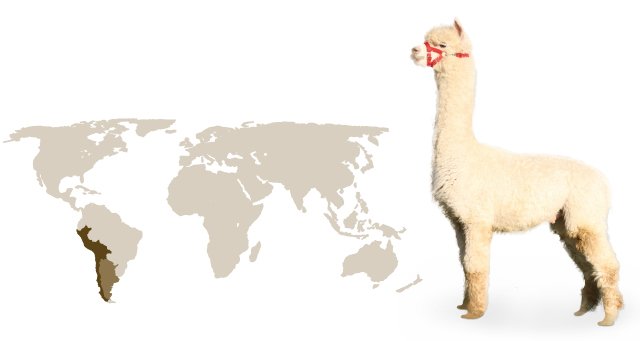
| Origin and distribution | Originally kept in herds on the level heights of the Andes of southern Peru, northern Bolivia, Ecuador and northern Chile; today Alpacas are bred almost all over the world |
| Habitat | High mountain pastures, steppe and veldt, semi-desert areas |
| Diet | Grass, shrubs, moss, lichen, hay, fresh and dry leaves |
| Behavior | Social herd animal |
| Life expectancy | Up to 20 years |
| Weight | 65 to 80 kg |
| Height at the withers | Up to 90 cm |
| Coat colors | Plain white, apricot, gray, brown and black; rarely spotted or appaloosa patterns |
| Breeds | Huacaya and Suri |
| Gestation period | 330-360 days |
| Foals | 1 per year |
| Characteristics | no hump; soft padded feet with two toes (Tylopoda); upper lip is split in two halves, pointed ears, soft fiber, furry head |